


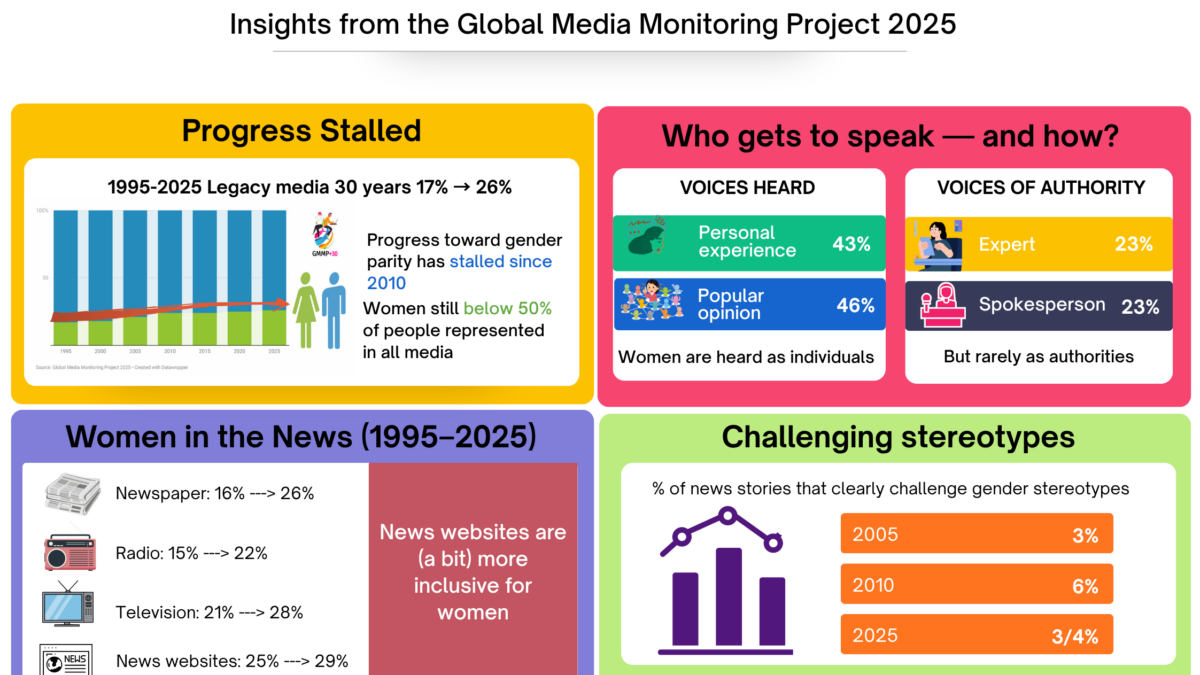
In its March 2026 meeting, the COPEAM Gender Equality & Diversity Commission dedicated a special focus to the Global Media Monitoring Project (GMMP) 2025—the world’s largest and longest-running study on gender representation in the news—sharing its latest findings and fostering collective reflection to drive more gender-equal media representation.
Thirty years after its launch, the GMMP confirms a persistent imbalance: women account for just 26% of people featured in the news globally. Despite some progress since 1995, improvement has largely stalled over the past decade, highlighting a significant gap between societal change and media representation.
The data reveal a structural issue. Women remain underrepresented not only in numbers, but also in roles: they are less likely to appear as experts or decision-makers, and more often portrayed as victims or in personal contexts. This imbalance is particularly evident in key areas such as politics, economics, and science.
Media gender inequality does not
reflect reality:
statistical analyses indicate
that between 65% and 75% is driven by
underlying structural factors that shape
how news is produced and presented
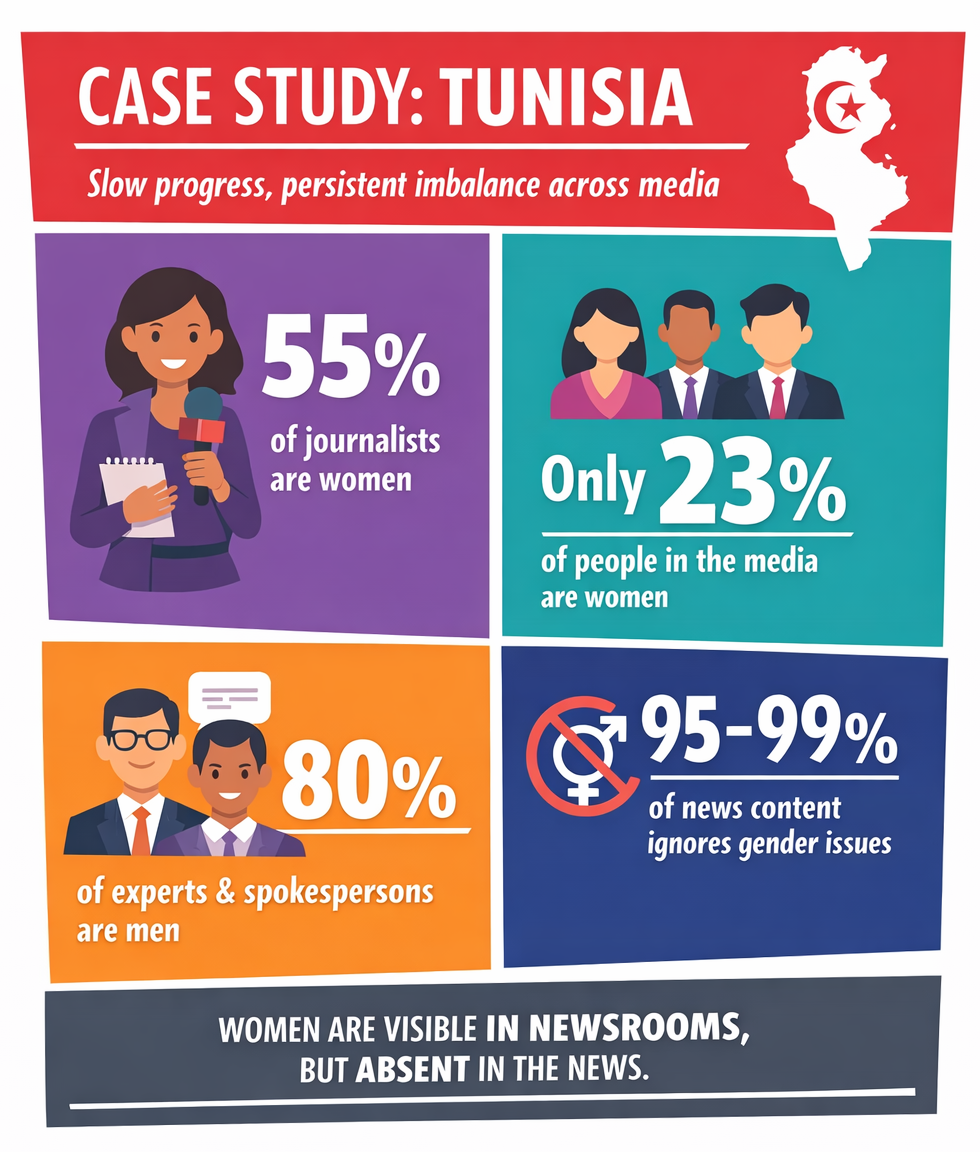
Importantly, the GMMP findings also show that increasing the number of women in newsrooms does not automatically lead to more balanced content. The case of Tunisia, among others, illustrates this paradox: while women make up the majority of journalists, they remain significantly underrepresented in media coverage.
These insights have been used as a basis for discussion and action, emphasizing the importance of data-driven approaches. Tools such as monitoring systems, expert databases, and targeted training programmes are essential to fostering more inclusive journalism.